
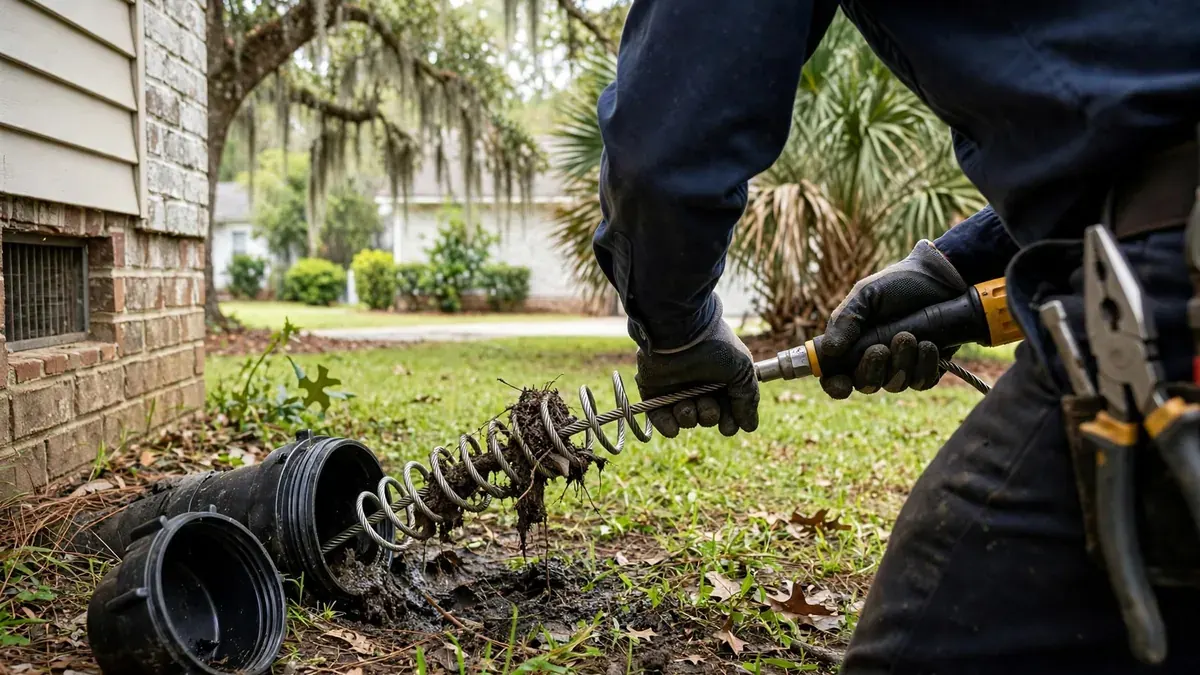
A drain that has stopped moving water is a real emergency once it starts backing up into a tub, a shower pan or a floor drain. Our drain cleaning line is staffed 24/7, nights and weekends included, and we send the next available plumber to your Port Hueneme address.
While you wait, stop running water in the house, skip the chemical drain opener, and keep the washing machine off. Chemicals sit in the pipe and splash onto whoever opens it next, and extra water only gives the blockage more to push back with.
Drain backup: what to do first and where the clog is
Where the water shows up tells us where the clog sits. One slow sink usually means a branch line. Two fixtures failing together, such as a tub and a toilet on the same wall, points to the shared line behind them. Water rising in the lowest drain in the house when you flush or drain a tub points to the main line, and that is the situation we treat as most urgent.
| What you notice | Likely location | Usual fix |
|---|---|---|
| One sink drains slowly | Trap or short branch line | Hand auger or small cable, trap cleaned |
| Kitchen sink and dishwasher back up | Kitchen branch with grease and food buildup | Cable with a cutting head, then a hot-water flush |
| Tub and toilet both gurgle | Shared bathroom branch | Cable through the closest cleanout or vent |
| Floor drain or tub fills when you flush | Main drain line | Main-line machine, camera check if it repeats |
| Same clog every few weeks | Roots, a belly, or a damaged joint | Camera inspection, then jetting or repair |
Kitchen sink clogs and the grease problem
Kitchen lines carry the worst mix in the house: cooled fat, coffee grounds, starchy rice and pasta water. The fat coats the pipe wall and each meal narrows it a little more until a spoonful of water stalls. We cable the line, cut the buildup free, and flush it with hot water so the loosened material leaves instead of settling downstream.
Port Hueneme runs a state-required fats, oils and grease program, and the city tells residents never to pour grease down a drain because it can back up into homes. That is a practical rule for you too, since a grease plug can form in your own line as easily as in the city line.
Snaking and cabling, step by step
Snaking means feeding a rotating steel cable into the drain until it reaches the blockage, then cutting or hooking it loose. Small sink machines use a quarter to three-eighths inch cable. Main-line machines use thicker cable and heavier heads for roots and compacted debris.
- We confirm which fixtures are affected and find the closest access point, usually a cleanout, a removable trap, or a toilet pulled off its flange.
- We pick the cable and cutting head that match the pipe size and the likely cause, then run it until the line moves freely.
- We flush with water to prove the line drains at full speed, not just enough to relieve the symptom.
- We explain what we found and whether a camera check or jetting makes sense before the clog returns.
What changes the price of drain cleaning
A drain job has no flat price because two clogs that look the same from the sink can be very different underneath. These are the factors that move the number.
Where the clog sits
A trap or a short branch is quick work. A main line behind a long run of pipe takes more cable and more time.
Access to the line
A cleanout makes the job simple. With no cleanout, we may need to pull a toilet or work from a roof vent.
Cause of the blockage
Soft buildup clears fast. Roots, a collapsed section or a foreign object can mean cutting tools or a repair.
Time of day
Night, weekend and holiday dispatch costs more to staff than a weekday booking.
Camera or jetting add-on
If the line is sound and only dirty, jetting may be worth adding. If it is damaged, a camera shows it first.
Homeowners insurance usually treats a clog as maintenance, so a standard policy rarely pays for clearing one. Water damage from a sudden backup may be covered, so read the policy or ask your agent before you throw anything away.
You get a clear price before work starts. Call (805) 249-7135 and describe what the drains are doing, and the dispatcher can narrow the range on the phone.
When the same clog keeps coming back
A cable opens a hole through a blockage but leaves some residue on the pipe wall. If the line fills again in a few weeks, the cause is usually still in the pipe: roots entering a joint, a low spot where water pools, or heavy scale on an old line. A camera shows which. For heavy buildup we recommend hydro jetting, which scours the full pipe wall with high-pressure water instead of punching a single channel.
If the camera finds a crack or a sag, no amount of cleaning will hold, and the honest answer is a repair. We walk through that option on the spot and leave the decision to you. Our sewer line repair page explains the choices for the section between the house and the street.
Older homes, renters and who to call
The city housing element puts roughly two in three Port Hueneme homes as built before 1980, so many drain lines in town have decades of use behind them. Older lines are more likely to have rough interiors where buildup catches, and joints that let roots in. That is why we look for a pattern instead of treating one clog as the whole story.
About half of Port Hueneme households rent. If you rent, tell your landlord or property manager about the backup first, because who pays depends on your lease and on the cause. We can give them a written description of what we found once the work is done.
Drain stopped at 2 a.m.? We answer.
Describe which fixtures are backing up and the dispatcher will tell you what to do while the plumber is on the way.
Clogs we handle most often
- Bathtub and shower drains packed with hair and soap scum, which a cable with a small head clears quickly.
- Toilet clogs that a plunger could not move, including ones caused by wipes, toys or too much paper.
- Laundry standpipes that overflow because lint and detergent residue narrowed the line.
- Floor drains in garages and utility rooms that smell or back up after rain or a heavy wash cycle.
- Main lines that carry every fixture in the house and have started to gurgle or hold water.
Leaks in the drain line itself, such as a slow seep under a sink or a damp spot along a wall, are a different problem. We check for them during the visit and move to leak detection if the symptoms point that way.
We serve addresses across Port Hueneme and the neighboring towns, including Oxnard and Channel Islands Beach. Whether the call comes from a home near Hueneme Beach Park or an apartment off Channel Islands Boulevard, the first question is the same: which drains are affected, and how fast is the water rising.
Questions about Drain Cleaning in Port Hueneme
Yes. The line is staffed 24 hours a day, every day. If a drain is backing up into the house at night or on a weekend, call (805) 249-7135 and the dispatcher books the next available plumber. Tell them which fixtures are affected so the right cable and cleaning tools are on the truck.
If two or more fixtures slow down together, or water shows up in the lowest drain in the house when you flush or drain a tub, the main line is the likely cause. A single slow sink is usually a branch.
The main line is the more urgent case because every drain in the house depends on it.
We advise against it. Chemicals can sit in a blocked pipe for hours and are hazardous to the person who opens it next. If you already used one, tell the plumber so they wear the right protection.
Yes. We match the cable and cutting head to the pipe size and material, and a camera inspection shows whether an older line is cracked or sagging before we apply more force.
The city maintains the public sewer system and runs a fats, oils and grease program, but a clog inside your house or on your own side line is normally yours to fix. If sewage is overflowing in the street or at a manhole, report it to the city wastewater line at 805-986-6556.