
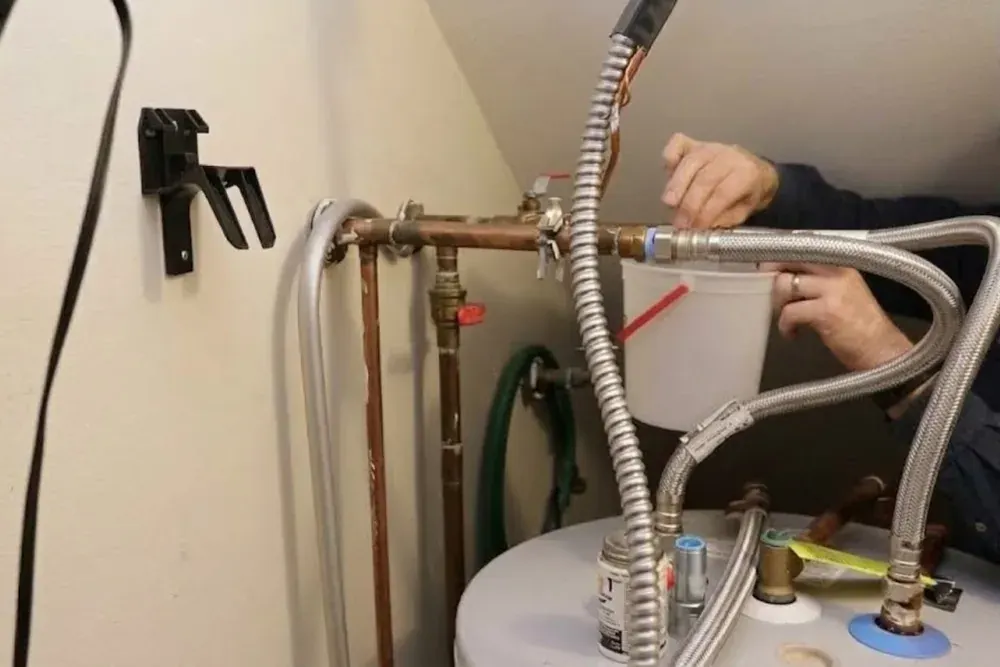
Where the thermostat is on a gas heater
Electric heaters have separate thermostats on the tank. Gas heaters usually do not. The thermostat is part of the gas control valve at the bottom of the tank, which also holds the pilot control, the dial and the safety shutoff. A probe extends into the tank to sense the water temperature, and the control opens and closes the gas to the burner.
That means a faulty thermostat is often a faulty gas control valve. A weak control can leave the water lukewarm, overshoot the setting or fail to relight. Because the part controls gas, a repair is a gas appliance repair, not a casual replacement.
Choose the right setting first
Before you decide the thermostat is bad, check the setting. The Consumer Product Safety Commission recommends setting a water heater to 120 degrees Fahrenheit. Its published burn times are a reason: a five-minute exposure at 120 can cause a third-degree burn, about 30 seconds at 130, about 6 seconds at 140 and about 2 seconds at 150. Older adults and children under five account for most tap-water scald injuries.
The Department of Energy also recommends 120 degrees. A lower setting saves energy and reduces scald risk. If your water seems too cool at 120, a longer wait or a mixing problem may be the real cause. The Commission says gas heater owners should follow the maker's instructions or call the gas company about the dial.
| Symptom | Likely cause | Next step |
|---|---|---|
| Water lukewarm at 120 | Sediment, weak flame or failing control | Flush, then test the control |
| Water scalding at 120 | Thermostat in the control stuck open | Turn the dial down, call for service |
| Pilot will not stay lit | Thermocouple or control | Test thermocouple, then control |
| Dial does not change temperature | Failed control valve | Replace the control valve |
| Smell of gas | Leak at a fitting or control | Leave the house and call SoCalGas |
Why we do not give do-it-yourself steps for the control
SoCalGas tells customers to use a licensed contractor for all gas appliance and venting repairs. The Contractors State License Board classification for plumbing contractors covers gas appliances, flues and gas connections, and maintaining gas safety and control devices. The Board also says unlicensed contractors may not do work on projects that need a permit or cost $1,000 or more in labor and materials.
A wrong connection on a gas control can cause a leak or a failed safety shutoff. That is why we leave the replacement to a licensed plumber and limit this page to what you can safely check yourself: the dial setting, the pilot light visible through the window, the breaker for any power-vent and the signs of sediment.
Port Hueneme note: gas safety and strapping
The gas utility serving this area is SoCalGas. Its emergency line is 1-800-427-2200 and is open 24 hours a day. Its guidance says if you smell natural gas or suspect a leak, leave the area at once, do not light flames or operate switches and call from a safe place, then call 911 if anyone may be in danger. It also says not to try to control the leak or repair a damaged pipe or meter yourself.
State law, in section 19211 of the Health and Safety Code, says residential water heaters must be strapped or braced against earthquakes, and a seller has to certify that when a home is sold. SoCalGas recommends strapping to wall studs in two places. Any plumber replacing a control should check the strapping while the tank is being worked on.
Water heater too hot or too cold?
Call and tell us the dial setting and what the water does. We test the control and tell you if it is a repair or a replacement.
Repair or replace the whole heater
If the heater is under eight years old and the control is the only fault, replacing the control is usually sensible. If the tank is older than ten to twelve years or leaking, a new control on a failing tank wastes money. We compare the numbers on the spot. Our water heater repair and water heater replacement pages explain both routes.
Sediment and hard water
The City of Port Hueneme reports hardness of about 210 milligrams per liter in its 2025 water quality report, roughly 12 grains per gallon by our conversion. Sediment from hard water collects at the bottom of the tank, where the burner heats from below. A layer of it makes the heater work harder and can mimic a thermostat problem. Draining and flushing the tank is a basic maintenance step that sometimes brings the water back to temperature.
Safety points to keep in mind
The thermostat on a gas heater is part of the gas control, which means the work involves a gas fitting. Water temperature, the pilot and the burner are all tied together in one assembly.
Set the dial for a safe delivery temperature. Many households settle near 120 degrees Fahrenheit because hotter water raises the scald risk, especially for children and older adults.
If the water is far hotter than the dial says, stop using the hot tap and call a plumber. A control that cannot shut the burner off is a safety problem, not a comfort problem.
We repair gas water heaters in Port Hueneme, Oxnard and Channel Islands Beach. In Oxnard the city reports even harder water, so sediment is a common cause of poor performance there.
Questions Port Hueneme homeowners ask
The Consumer Product Safety Commission and the Department of Energy both recommend 120 degrees Fahrenheit. Higher settings raise scald risk quickly.
Usually not. On most gas heaters the thermostat is part of the gas control valve at the bottom of the tank.
We advise against it. SoCalGas says to use a licensed contractor for gas appliance repairs, and a wrong connection can cause a gas leak.
Leave the house, then call SoCalGas at 1-800-427-2200 from a safe place and 911 if anyone may be in danger.