
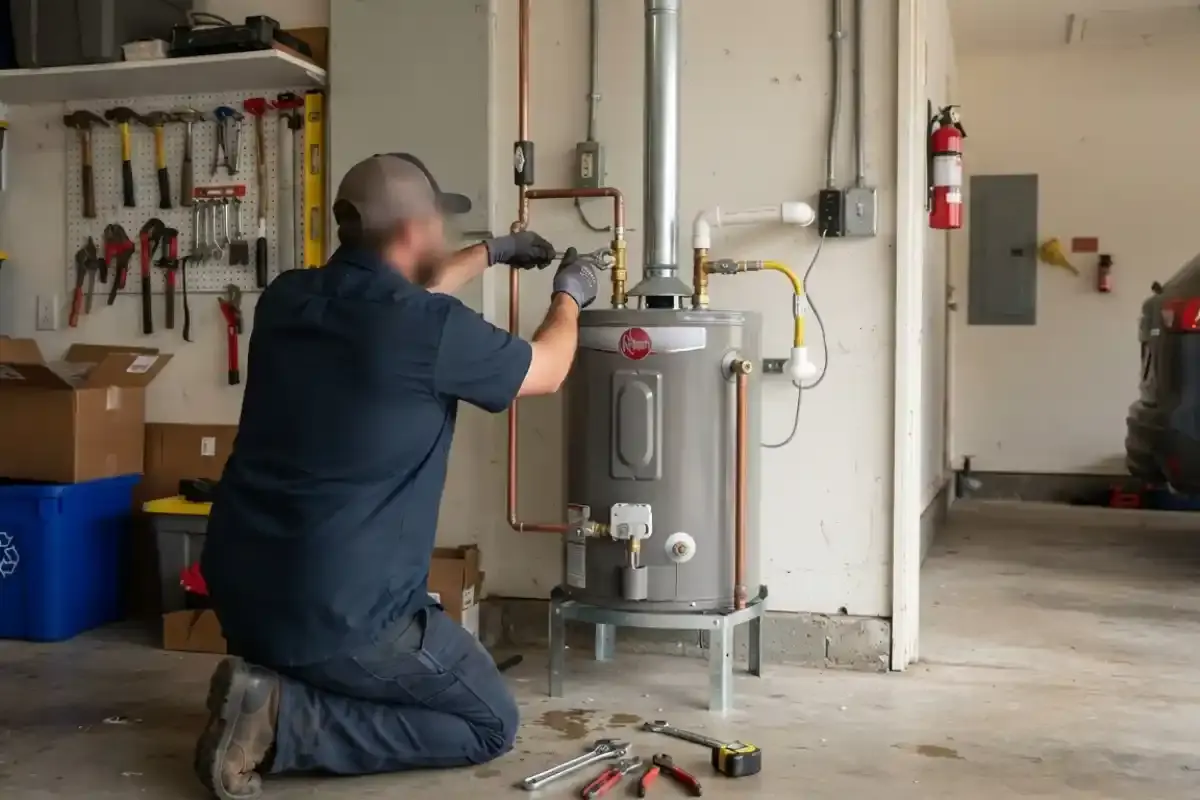
Why a tank needs flushing
Minerals in the water settle to the bottom of a tank as it heats. Over time they form a layer of sediment. On a gas heater the layer sits between the burner and the water, so the burner works harder. On an electric heater it can bury the lower element. Either way the heater loses efficiency, and you may hear popping or rumbling when trapped water boils beneath the layer.
The Department of Energy's Energy Saver guide suggests draining about a quart of water from the tank every three months to remove sediment, following the maker's directions. A full flush a year is common practice, and a heater that has never been drained may need more than one pass.
Port Hueneme water is hard
The City of Port Hueneme 2025 water quality report lists total hardness at about 210 milligrams per liter in the blended supply. That is roughly 12 grains per gallon by our conversion. It is the kind of water that builds sediment steadily. In Oxnard, where the city reports an average closer to 419 milligrams per liter, the buildup can be faster still.
| Situation | Suggested schedule | Why |
|---|---|---|
| New heater, hard water | Quick drain every few months, full flush yearly | Prevent a thick layer from forming |
| Heater never flushed, over 5 years | Ask a plumber first | Hard sediment may clog the drain valve |
| Heater with a softener upstream | Yearly check | Less sediment, still worth a look |
| Tankless unit | Descale on the maker's schedule | Scale coats the heat exchanger |
How to flush a tank heater
- Turn off the heater. Set a gas unit to pilot or off and switch an electric unit off at the breaker.
- Close the cold water supply valve at the heater.
- Open a hot tap in the house to let air in so the tank drains.
- Attach a garden hose to the drain valve at the bottom of the tank and run it to a floor drain or the yard.
- Open the drain valve and let water run. It will be hot, so keep the hose end away from people and pets.
- Briefly open the cold supply to stir the sediment and let it run until the water runs clear.
- Close the drain valve, remove the hose, close the hot tap and open the cold supply.
- Let the tank fill fully before turning the power or gas back on, so an electric element is never energized dry.
If the drain valve is plastic and clogged with sediment, stop. Forcing it can break it and leave you with a flood. A plumber can replace it with a brass valve and clear the sediment safely.
Port Hueneme note: strapping and safety
California Health and Safety Code section 19211 requires water heaters to be braced, anchored or strapped against earthquake movement, and sellers must certify compliance. SoCalGas recommends strapping to wall studs in two places, and says garage heaters should have their ignition source at least 18 inches above the floor unless local code says otherwise. While you are at the heater, check that the straps are tight.
The gas utility in this area is SoCalGas, with an emergency line at 1-800-427-2200. If you smell gas at any point, leave the house and call from a safe place. We did not find a city rule requiring a permit for a routine flush. Building and Safety at 805-986-6512 can answer questions about heater replacement permits.
Heater noisy or slow to heat?
Call and tell us the age and what you hear. We flush it or tell you if it is time for a new one.
Anode rods and other upkeep
Many tanks have a sacrificial anode rod that corrodes instead of the tank. Replacing it can extend the life of a heater, but we did not find a primary-source guide to share, so we recommend asking a plumber to inspect it on an older tank. A relief valve test, a look for rust at the base and a check of the strapping round out basic upkeep.
If the flush brings out heavy sediment, the tank may be near the end of its life. A tank that is ten to twelve years old and leaking at the base is past repair. See water heater replacement for what that involves and water heater repair for part failures.
When not to DIY
- The heater is a tankless unit, which needs descaling with a pump and solution.
- The drain valve is plastic, stuck or leaking.
- The tank has never been drained and is more than five years old.
- The heater is in a tight closet or attic where a spill would cause damage.
- You smell gas at any time.
Safety and tools
Turn the heater to its pilot or vacation setting, or switch off the breaker on an electric model, before you start. Never run an electric element dry.
Let the water cool for a while. The first water out of a hot tank can scald, and a garden hose will not stand it.
Stop if the drain valve will not close afterward or drips. Old plastic drain valves can crack, and replacing one is a small job that is worth doing before it fails on its own.
We flush and service water heaters in Port Hueneme, Oxnard and Channel Islands Beach. For tankless units, see tankless water heater service, and for scale at the taps, see water softener and filtration.
Questions Port Hueneme homeowners ask
The Department of Energy suggests draining about a quart every three months and a full flush is commonly done yearly. With about 12 grains per gallon of hardness, we lean toward the shorter end.
It can loosen sediment that was sealing a small leak or break a brittle drain valve. If the heater is old and has never been flushed, ask a plumber first.
Yes. Set a gas heater to pilot or off, and switch an electric heater off at the breaker. Never run an electric heater with the tank empty.
Often it helps, since the noise comes from water boiling beneath sediment. A heavily scaled tank may need replacement.